
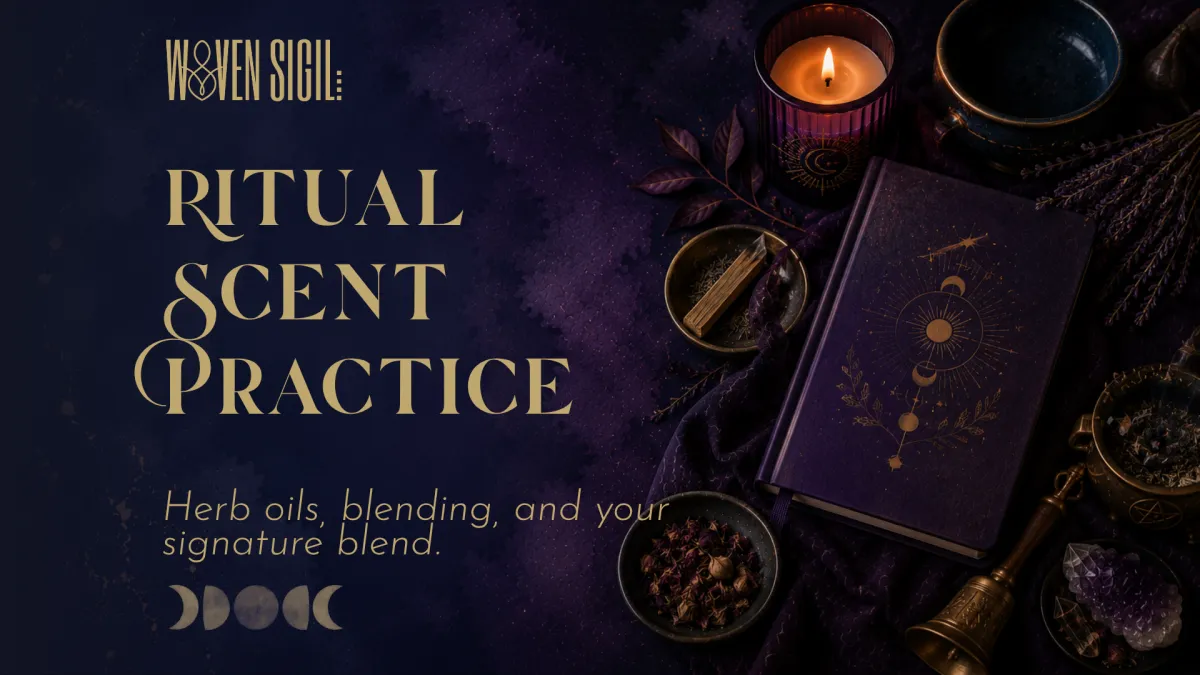
How to Build a Ritual Scent Practice: Herb Oils, Correspondences, and Your Signature Blend
Somewhere in the past few years, the fragrance world started calling it "scent stacking" — layering multiple oils or perfumes to create something personally yours rather than reaching for a single signature bottle. Searches for niche, botanical-based scents have grown dramatically, and people are increasingly interested in building a scent identity they assembled themselves rather than one they bought pre-packaged.
For anyone already working with herbs and ritual, this isn't particularly new territory. Using scented oils, infused herbs, and botanically-based blends as part of spiritual practice is one of the oldest aspects of ritual work across cultures. What's new is that it's meeting an audience that might not have come to it through spiritual practice at all — and it’s a good opportunity to think about what ritual scent actually does and how to build a practice around it intentionally.
This guide covers the practical side: how to choose and work with ritual oils, what the basic correspondences look like, and how to develop a scent practice that's genuinely connected to your intention rather than just aesthetically pleasant.
Why Scent Works in Ritual
Scent is processed differently than any other sense. The olfactory pathway bypasses several stages of sensory processing and connects more directly to the limbic system — the part of the brain associated with memory, emotion, and automatic response. This is why a smell can bring back a memory before you've consciously registered what you're smelling, and why specific scents can shift your mood in a way that feels almost physical rather than cognitive.
In ritual terms, this is useful because scent creates an immediate, involuntary shift in state. If you always light the same incense or apply the same oil before entering a ritual or meditative practice, your nervous system eventually begins to associate that scent with that mode of attention. The scent becomes a cue, and the cue becomes a fast-track to the state you're trying to access. It's classical conditioning, and it's one of the more practical reasons why consistent ritual anchors work.
Over time, your ritual scent can also hold memory in a different way: the smell of a particular blend can bring you back to a specific reason for your practice, a particular emotional state, a turning point. That kind of memory is part of what makes a personal scent practice more meaningful than a random selection.
The Basics: What You're Working With
Ritual scent work draws from several categories of material, each with different properties and uses.
Essential oils are highly concentrated plant extracts — the aromatic compounds distilled or cold-pressed from flowers, leaves, bark, resin, roots, or fruit. They're potent and should almost never be applied directly to skin without dilution. A few drops in a carrier oil is the standard approach for any topical use.
Carrier oils are the neutral or lightly scented oils you use to dilute essential oils for skin application. Jojoba, sweet almond, fractionated coconut, and apricot kernel are the most common. Your choice of carrier oil can be part of the intention: jojoba is shelf-stable and absorbs cleanly; coconut has its own light scent and protective properties; apricot kernel is particularly gentle for sensitive skin.
Herb-infused oils are made by steeping dried herbs directly in a carrier oil over several days or weeks. The result is subtler than an essential oil — softer, warmer, more complex — and often feels more personal precisely because you made it yourself. They're also more appropriate for many types of ritual use where you want the plant's presence without the intensity of a concentrated extract.
Resins and solids — frankincense, myrrh, copal, beeswax-based balms — are less common in a beginning practice but worth knowing about. Some practitioners prefer solid perfumes or resin-based blends for their slower release and longer-lasting presence.
Incense and smoke technically belong to scent practice too, though this guide focuses on topical and diffused oils. If you already work with incense, the correspondence principles below apply equally to choosing or blending what you burn.
Correspondences as a Starting Vocabulary
Herbal and plant correspondences in spiritual practice are a tool, not a rule. They represent accumulated cultural and experiential associations — what certain plants have historically been connected to, what qualities practitioners have found them useful for, what the plant's actual physical properties suggest about its energetic uses.
You don't need to accept correspondences wholesale, and you're not required to agree with every attribution in every tradition. Some of them will resonate immediately; others will feel arbitrary to you. Start with the ones that feel true and build from there.
Some common correspondence associations that hold up well across multiple traditions:
Lavender — calm, clarity, sleep, stress reduction. One of the most versatile and well-documented plants in both herbal medicine and ritual practice. Good for settling a scattered mind before meditation or ritual, for sleep preparation, and for situations where you need to access presence rather than drive.
Rosemary — mental clarity, memory, purification, protection. The smell is immediately activating rather than calming. Useful for ritual work that requires focus and cognitive sharpness, or for clearing a space’s energy before beginning practice.
Frankincense — spiritual connection, elevation of consciousness, slowing and deepening breath. Used in religious and spiritual contexts across cultures for thousands of years. The resin and its essential oil are both appropriate for meditation and any practice where you want to signal a shift from ordinary awareness to something more intentional.
Mugwort — dream work, liminal states, psychic opening, the subconscious. Traditionally associated with the threshold between waking and sleep, with visionary states, and with the moon. Often used in small amounts in dream pillows or as a very light oil for bedtime practices. Not appropriate for use during pregnancy.
Sandalwood — grounding, presence, warmth, deepening. One of the most effective base notes for ritual blends because it slows and grounds the effect of other oils. Also traditionally associated with meditation and ceremony.
Rose — love (all forms, not only romantic), the heart, beauty, receptivity. Rose absolute or rose-infused oil is expensive but potent in very small amounts. Often more useful in practices involving self-love, grief, or the heart than in more practically-focused ritual work.
Cedarwood — strength, stability, connection to ancestral wisdom, protection of space. Warmer and more grounding than rosemary, with less sharpness. Good as a base note in blends meant to establish or protect a space.
Peppermint — clarity, energy, cleansing, activation. Sharp and cooling. Less common in ritual oils because of its intensity, but useful in blends for mental activation or in very small amounts to cut through heaviness.
Building a Blend: The Practical Process
Blending ritual oil doesn't require specialized training, but it does benefit from slowing down and working with intention rather than trying to engineer a "correct" result.
Start with your intention, not the ingredients. Before you choose any oils, sit with the question of what this blend is for. Is it for focus before creative work? For sleep and dream access? For a specific ritual or seasonal practice? For daily anointing as a way of setting intention in the morning? Your intention shapes which plants belong in the blend, not the other way around.
Work with a simple structure: top, middle, and base notes. In perfumery, notes refer to how quickly a scent dissipates after application. Top notes are the first thing you smell and the quickest to fade — citrus, light herbal scents. Middle notes form the body of the blend and last longer — lavender, rosemary, rose, clary sage. Base notes anchor the blend and linger longest — sandalwood, cedarwood, frankincense, patchouli, vetiver. A blend with all three layers will develop on the skin over time rather than fading quickly, and tends to feel more complex and complete.
Dilution ratios for skin application. A 2–3% dilution is generally considered safe for most skin types for regular use. That translates to roughly 12–18 drops of essential oil per ounce (30ml) of carrier oil. If you're making a blend for a particularly sensitive area or for sensitive skin, err toward 1% (6 drops per ounce). Test on a small patch of skin before using extensively.
The process itself. Add your carrier oil to a small dark glass bottle (amber or cobalt glass protects the oil from light degradation). Add your essential oils one at a time — start with the base notes, then middle, then top. Use a toothpick or small stirrer to blend gently rather than shaking. Let the blend rest for 24–48 hours before using it; the notes will integrate and the scent will change as it settles. Write down what you used and in what proportions so you can recreate or adjust it.
Sample Blends to Start With
These are starting points, not formulas. Adjust based on what resonates.
Focus and clarity blend (for creative work, study, or any practice requiring a sharp, engaged mind): rosemary as the dominant middle note, a touch of peppermint for activation, cedarwood as a grounding base.
Meditation and presence blend: frankincense as the primary note, sandalwood as the base, a small amount of lavender to quiet the nervous system.
Dreamwork blend: mugwort-infused oil as the carrier, a few drops of lavender, a very small amount of cedarwood. Used on the wrists or chest before sleep, not applied heavily.
Seasonal ritual blend for late summer: cedarwood base, rosemary middle, a drop of orange or bergamot for warmth. The citrus top note fades quickly but provides an opening brightness before the warmer notes take over.
Using Your Scent Practice in Ritual
The most common application is anointing — applying a small amount of oil to pulse points (wrists, temples, sternum, back of the neck) as a way of opening ritual space or marking a transition from ordinary time to intentional time. The act of anointing itself, done slowly and with attention, is a small ritual in its own right.
You can also add a few drops to bath water for ritual bathing, diffuse in a room before a ceremony or meditation session, anoint ritual objects or tools, or use a very small amount applied to the edge of a journal or workbook before a significant writing session.
The practice doesn't need to be elaborate. The point is the intention behind it and the consistency that builds an association over time — not the complexity of the application.
A Note on Sourcing
The ethics of plant sourcing matter more than they're often discussed in spiritual spaces. Some herbs and resins are overharvested to the point of genuine ecological concern — wild white sage being the clearest example, but also frankincense (the resin comes from trees that are being tapped faster than they can recover) and several other botanicals that have become fashionable in recent years.
Before you buy any plant material, it's worth a quick look at where and how it was sourced. Organically grown, ethically wildcrafted with attention to the local population, or cultivated specifically for harvest — these distinctions matter. Personally, I'd rather buy an herb than harvest it from the wild if I'm not sure the local population can handle it. A spiritual practice rooted in relationship with the land has to include the actual state of the land, not just the aesthetic of it.
As always, use your own discernment and consult a qualified medical practitioner for anything related to your physical health. Essential oils are potent, some are contraindicated during pregnancy or with specific medications, and what works well for one person's skin may not work for another's. Start with small amounts, dilute appropriately, and pay attention to how your body responds.
The Longer Practice
A ritual scent practice deepens with time and attention rather than with the accumulation of more materials. You don't need twenty oils to do this meaningfully. Some of the most grounded practitioners I'm aware of work with four or five oils they know deeply rather than a vast collection they've only sampled.
Pay attention to which scents your body pulls toward in different seasons, different emotional states, different phases of your practice. Track it in your journal if you keep one. The pattern that emerges is its own kind of information — about what your system is asking for, about which plants have become genuine allies in your practice rather than passing interests.
That relationship, accumulated slowly over time, is what makes a scent practice sacred rather than just aromatic.