
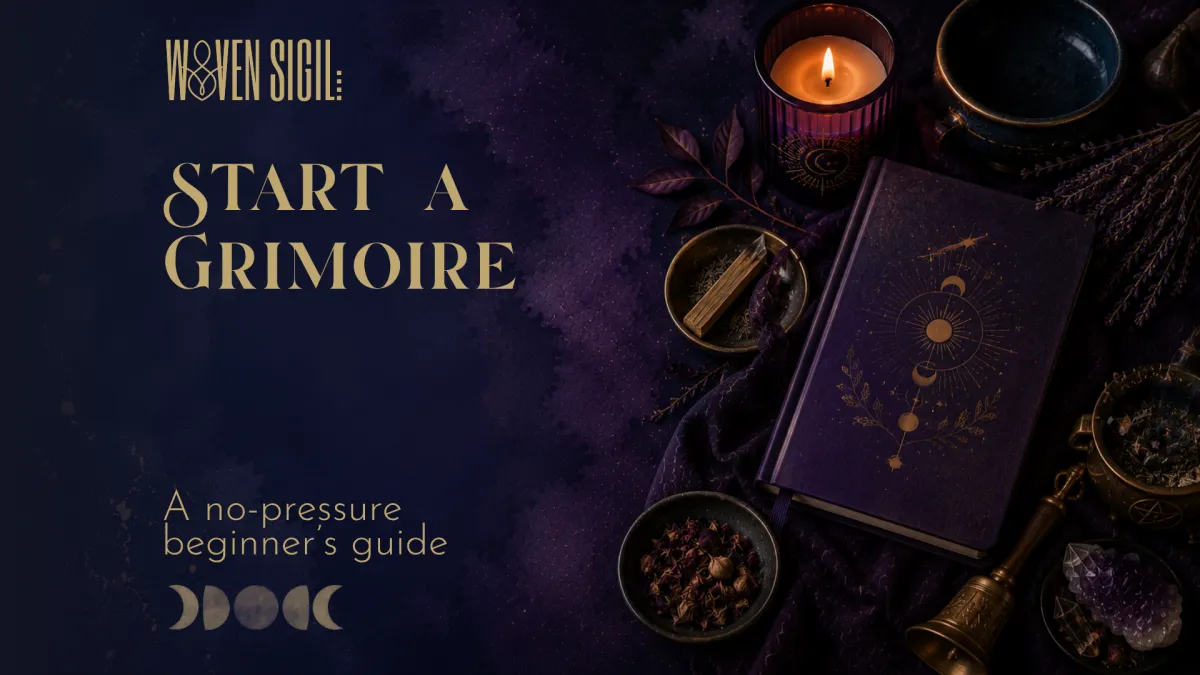
How to Start a Grimoire: A No-Pressure Beginner's Guide
At some point, almost everyone who starts building a personal spiritual practice hits the same quiet wall: they decide they want a grimoire, buy a beautiful blank notebook, and then sit there completely frozen, unsure what page one is supposed to say. If that's where you are right now, you're not behind, and you're not doing this wrong. You just haven't been told yet that there isn't a wrong way to begin.
This guide exists for that exact moment — the one right before you start, when the blank pages feel more intimidating than inviting.
What a Grimoire Actually Is
The word "grimoire" gets used loosely across modern spiritual spaces, which causes more confusion than it solves. Historically, the term referred to a book of magical knowledge and spellcraft, often passed down or copied by hand across generations. Some traditions distinguish a grimoire from a Book of Shadows, treating the former as a more general reference text and the latter as a personal record of one practitioner's rituals and experiences.
For the purposes of a modern, personal, non-dogmatic practice, the distinction matters less than you'd think. What you're actually building is a working record of your own spiritual life — part journal, part reference book, part memory-keeper. Call it a grimoire, a Book of Shadows, a practice journal, or nothing at all. The name is far less important than the fact that you're keeping one.
You are not required to follow any tradition's specific format for this to count as a real grimoire. You're not required to have any particular belief system, either. If you're drawn to ritual, symbolism, and intentional living, and you want a place to track how that unfolds for you personally, that's already enough of a reason to start.
Why the Blank Page Feels So Hard
Before getting into the practical setup, it's worth naming why this specific project trips people up more than most journals do. A grimoire carries an unusual amount of implied weight — it's supposed to hold your "real" practice, which can quietly translate into pressure to already know what your real practice is before you've even started building it.
There's also a strong current online of extremely polished, aesthetically perfect grimoire pages — hand-lettered headers, pressed flowers, elaborate borders — that can make a first attempt feel embarrassing by comparison. It's worth saying directly: those pages were built over months or years, not written in one sitting, and most of them left out dozens of rough early entries that never got photographed.
Perfectionism is the single biggest reason grimoires get abandoned. Knowing that in advance can help you sidestep it.
Digital or Physical? Neither Is More "Real"
One of the most common points of hesitation is the format question — should this be a physical notebook or a digital file? There's no correct answer here, and claims that one is inherently more spiritually valid than the other don't hold up under much scrutiny.
A physical grimoire offers a tactile, offline experience. Writing by hand tends to slow your thinking down in a way that can deepen reflection, and there's something to be said for a book that exists independently of a screen or a password. The tradeoff is portability, searchability, and the risk of damage or loss.
A digital grimoire, built in something like Notion, a simple document, or even a well-organized folder of notes, offers searchability, easy backup, and the ability to reorganize as your practice evolves. The tradeoff is that it's harder to make it feel as personal or ceremonial, and it ties your practice to a device.
Plenty of people run both — a physical notebook for ritual work and reflection, and a digital file for reference material and correspondences that benefit from being searchable. There's no rule against a hybrid approach, and it's often the most practical one.
What Actually Goes Into a Grimoire
This is usually the real question underneath "where do I start" — not the format, but the content. Here's a grounded starting list, not a required checklist:
A simple intentions or values page. A short note on why you're building this practice and what you're hoping it gives you. This page is worth rereading in six months, if only to see how much has shifted.
Correspondences you actually use. Herb meanings, moon phase notes, color associations, tarot card interpretations — but only the ones relevant to what you're currently exploring. You don't need to copy an entire reference encyclopedia on day one.
A record of rituals you've done. What you did, roughly when, and how it felt afterward. This becomes genuinely useful over time, because it lets you notice which practices actually help you and which ones you keep doing out of habit rather than benefit.
Journal entries tied to specific practices. Moon rituals, seasonal observances, tarot pulls — a few honest sentences after each one, rather than a polished essay.
Dreams worth remembering. Not every dream, just the ones that stuck with you or seemed to connect to something you're working through.
A "still figuring this out" section. This one matters more than it sounds like it should. A place to note open questions, half-formed ideas, and practices you're curious about but haven't tried yet. Permission to be unfinished, kept in writing.
A Simple Starter Template
If a blank notebook is the thing stopping you, here's a minimal structure you can copy directly into the first several pages of a physical or digital grimoire. Each of these can be a single page or a whole section, depending on how much you want to write.
Why I'm doing this — a page, or even a paragraph, on what drew you to this practice.
What resonates with me so far — symbols, practices, or ideas you're already drawn to, even loosely.
A running ritual log — a simple running list: date, what you did, how it felt.
Correspondences as you learn them — add pages as you go rather than trying to front-load a complete reference section.
Reflections and open questions — the "still figuring this out" space mentioned above.
That's five sections. You can start with a single sentence in each and let the rest fill in naturally over months. There is no deadline for finishing a grimoire, because a grimoire that's actually being used is never finished.
Handwriting Style, Decoration, and Other Things That Don't Matter
A quick, direct note on something that stops a lot of people before they start: your handwriting does not need to be beautiful, your pages do not need borders or illustrations, and you do not need calligraphy skills, watercolor washes, or pressed botanicals for any of this to be legitimate.
If decorating your pages is something you genuinely enjoy, do it — it can be a lovely, meditative part of the process. But if you're avoiding starting because you feel like your plain handwritten notes in a $4 notebook aren't "grimoire enough," that belief is the actual obstacle, not your notebook.
Some of the most useful, well-loved grimoires in circulation are visually unremarkable and full of crossed-out lines, half-finished thoughts, and coffee stains. That's what a working document looks like.
How to Organize It Without Over-planning
A reasonable middle ground between "no structure at all" and "elaborate tabbed system before you've written a single entry" is to build loosely by section, and let subsections emerge once you actually have enough material to need them.
Start with broad categories — something like rituals, correspondences, reflections, and reference — and don't worry about subdividing further until one section gets crowded enough to need it. If your correspondences section eventually splits naturally into herbs, crystals, and moon phases, that's a sign your practice has grown, not a sign you organized it wrong the first time.
If you're using a physical notebook, leaving a few blank pages between sections gives you room to expand later without needing to start an entirely new book. If you're working digitally, this isn't a concern at all — you can always add a new page or subpage.
Starting Mid-Practice Instead of at the Beginning
If you've already been practicing for months or years without keeping any written record, you might feel like it's "too late" to start a grimoire now, as though you've missed some window. You haven't. A grimoire doesn't need to document your practice from day one to be valid. It only needs to document your practice from whatever day you actually start writing in it.
If it feels meaningful, you can open your first entry with a brief look back — a short summary of how you got here, what you've explored, what's stuck and what hasn't — before moving forward from that point. But this is optional, not required. Plenty of people simply start on page one with today's date and never look back further than that.
What to Do When You Fall Behind
Almost everyone who keeps a grimoire goes through stretches where they don't write in it for weeks or months. This is completely normal, and it doesn't mean you've failed at the practice or need to start over with a fresh notebook.
When you come back to it, you don't owe it an explanation or a catch-up entry summarizing everything you missed. Just pick back up from wherever you are now. A gap in the pages is not a flaw in the document. It's just a period where your attention was somewhere else, which happens to everyone, spiritual practice or not.
Tools and Supplies
None of this requires a shopping trip. A grimoire can be built with a notebook you already own and a pen from a kitchen drawer. But if gathering a few supplies helps make the project feel intentional, here's what tends to be genuinely useful rather than just decorative:
A notebook with a binding that lays flat if you're writing by hand often, since spiral or lay-flat bindings are easier to work in over long sessions. A pen you actually enjoy writing with — this sounds minor, but a pen that skips or drags will quietly discourage you from writing more than a sentence. Sticky tabs or a simple index page if you anticipate wanting to find entries quickly later. That's genuinely the full list. Pressed flowers, wax seals, and gilded page edges are lovely if you want them, but they're closer to hobby crafting than they are to necessary grimoire infrastructure.
Important Note: For those of you too afraid to get started because you feel like you may ruin your book—If you use a post-bound book or 3-ring binder with loose pages, or a disc bound system, you can move handwritten pages a million times if you want to.
Connecting Your Grimoire to the Rest of Your Practice
A grimoire works best when it isn't a separate, isolated project sitting apart from everything else you do. If you already pull tarot cards occasionally, your grimoire is a natural place to log the card, the question, and your read on it, even briefly. If you mark moon phases or seasonal sabbats, a short entry after each one builds a record you can look back on year over year — which is often the point where a grimoire starts to feel genuinely valuable, once you have enough entries to notice patterns.
If you keep an altar, your grimoire can hold notes on why certain objects are there and when you last changed them out. None of these connections need to happen immediately. They tend to develop naturally once the grimoire itself becomes a normal part of your practice rather than a separate obligation.
A Realistic First Month
If you'd rather have a loose sense of pacing than an open-ended "just start" instruction, here's roughly what a first month of grimoire-keeping tends to look like for someone starting from nothing.
In the first week, most of the writing is foundational — the why-I'm-doing-this page, a few early reflections, maybe your first correspondence entries for things you already know a little about. It often feels slow and a little unsure, which is completely normal.
By the second or third week, entries usually start attaching themselves to specific moments — a ritual you did, a dream that stuck with you, a moon phase you observed. The book starts to feel less like an assignment and more like a running conversation with yourself.
By the end of the first month, many people notice their entries have shifted from formal-sounding to more natural, almost like the difference between a first journal entry and a hundredth one. That shift is a good sign. It usually means the grimoire has stopped feeling like a project and started feeling like a habit.
Questions That Come Up Often
Do I need to bless or consecrate my grimoire before using it? Only if that's meaningful within your own practice. Plenty of people simply start writing. If a small opening ritual — a lit candle, a few quiet words about your intentions for the book — feels right to you, there's nothing wrong with doing that either. It isn't a requirement.
Can I use a regular notebook, or does it need to be special? A regular notebook works completely fine. The notebook doesn't do the work; you do.
What if I want to start over with a new one? You're allowed to. Some people transfer favorite entries into a fresh notebook once an old one fills up or no longer feels aligned with where their practice has moved. Nothing is lost by doing this, and it doesn't erase the value of what you wrote in the first one. See the Important Note under Tools & Supplies.
Should I keep it private? That's entirely your call. Some people keep their grimoire somewhere private simply because the entries feel personal, similar to a diary, not because there's anything secretive about the practice itself. If privacy matters to you, a drawer, a closed notebook on a shelf, or a password-protected digital file all work well.
A Grimoire Isn't a Performance
It's worth returning to this point one more time before closing, because it's the thing most likely to quietly sabotage a new grimoire: this book is not for anyone else's approval, and it never needs to be shown to anyone if you don't want it to be.
You don't need it to look impressive in a photo. You don't need every entry to sound wise or poetic. You don't need to have your symbolism system fully worked out before you're "allowed" to start recording it. The entire value of a grimoire comes from its honesty, and honesty tends to disappear the moment you start writing for an imagined audience instead of for yourself.
If you want to eventually share pieces of it — with a friend, a partner, an online community — that's completely fine too. Just build it for yourself first.
How Your Grimoire Changes as You Do
One thing rarely mentioned in beginner guides: the grimoire you start with will probably look very different from the one you're keeping a year or two from now, and that's not a flaw in the process. It's the process working correctly.
Early entries often lean heavily on borrowed material — correspondences copied from a book or a website, rituals following someone else's exact structure, language that sounds a little like whatever source you were learning from. That's a completely normal starting point. Over time, most people notice their entries start sounding more like their own voice, their correspondences start reflecting their own observed experience rather than a textbook definition, and their rituals start bending to fit their actual life instead of a template.
If you look back at an early entry and cringe slightly, or wonder why you wrote something so simplistic, take that as a good sign rather than an embarrassing one. It means you've grown since then, and the book did its job of capturing where you actually were at the time, rather than where you wished you'd already been.
Common Doubts That Aren't a Sign You're Doing It Wrong
A few worries come up often enough among people starting a grimoire that they're worth naming directly, so you can recognize them for what they are rather than treating them as evidence you're somehow unsuited for this practice.
Feeling like your entries are "boring" compared to what you imagine other people write. Most grimoires, including impressive-looking ones, are full of ordinary, unglamorous entries. The interesting parts tend to accumulate slowly, not appear from the first page.
Worrying that you don't know enough yet to write anything meaningful. A grimoire is where you learn, not a place you're only allowed to write in once you already know the material. Recording what you're currently learning, including the parts you're unsure about, is exactly what the book is for.
Feeling inconsistent compared to people who seem to post grimoire pages constantly online. What gets shared publicly is a curated, unrepresentative sample of anyone's actual practice. Consistency in a private, honest way matters more than visible frequency.
None of these doubts mean you're approaching this wrong. They're just common friction points on the way to a habit that hasn't fully settled in yet.
Getting Started Today
If you've been putting this off, here's the smallest possible version of a first step: open a notebook, or a blank document, and write one sentence about why you wanted to start a grimoire in the first place. That's it. That single sentence is now the beginning of your practice record, and everything else can be built around it at whatever pace actually fits your life.
There's no perfect notebook, no correct first entry, and no committee evaluating whether you're doing this "right." There's just you, a blank page, and whatever you're genuinely curious about exploring next.
Take your time with it. A grimoire built slowly and honestly will always be more useful to you than one built quickly to look finished.
If you're also thinking about where to keep the rest of your practice organized — correspondences, moon tracking, ritual planning — a digital companion to your physical grimoire can make the reference side of things easier to search later, without replacing the personal, handwritten heart of the book. That's a separate project for another day, though. For now, the notebook and the first sentence are enough.