
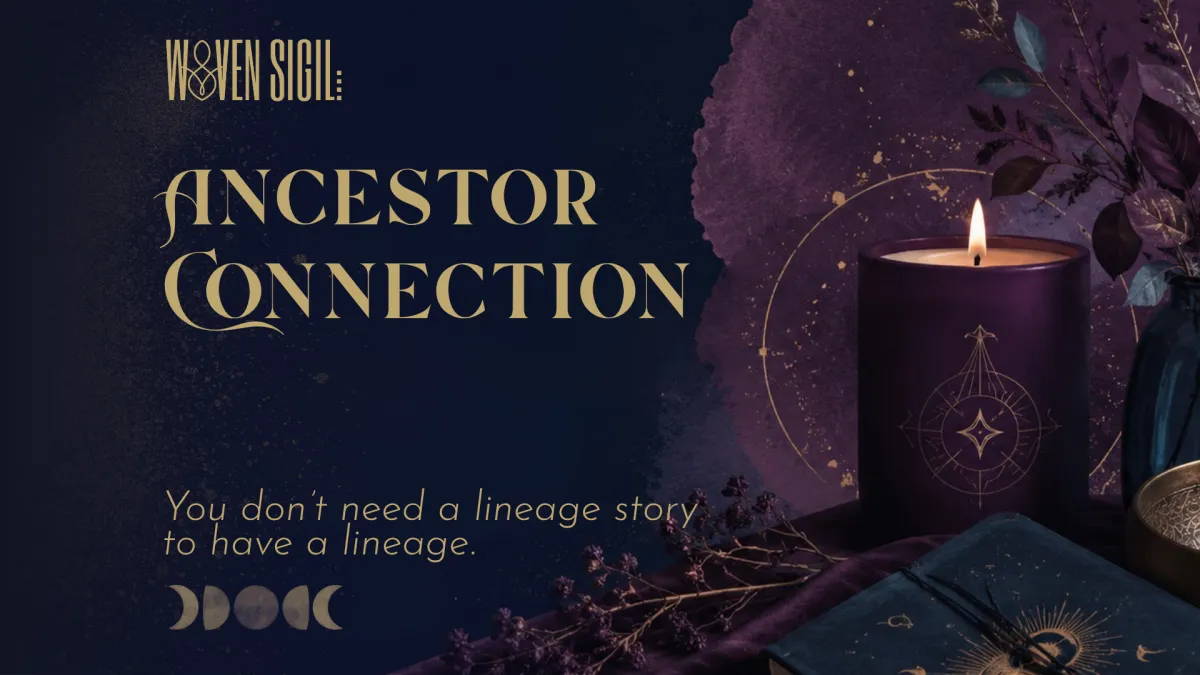
Connecting with Your Ancestors Without a Tradition to Follow
Most people who want to work with their ancestors hit the same wall: they don't have a tradition. No intact lineage practice. No cultural framework still in use. Maybe a family that didn't talk about this kind of thing, or a heritage scattered across enough geographic and cultural distance that there's no obvious starting point. They know something draws them to this, but they don't know whose permission to ask, or what the rules are, or whether they're even allowed to do it without a specific tradition guiding them.
The answer is that ancestor connection, at its simplest, doesn't require a tradition. It requires memory, attention, and the willingness to acknowledge that the people who came before you are worth acknowledging.
That's really all you need to begin.
What “Working with Your Ancestors” Actually Means
Before getting into the how, it's worth being clear about the what — because “ancestral work” can mean very different things depending on who's describing it.
In some spiritual frameworks, ancestor work involves direct communication: speaking to the dead, receiving guidance, maintaining ongoing relationships with spirits of the deceased. In others, it's more symbolic — honoring lineage as a way of acknowledging where you came from, the struggles and gifts that made your life possible, the chain of human experience that connects you to the past.
Neither is more valid than the other. What matters is which framework actually resonates with you and what you honestly believe or want to engage with. If spirit communication feels true to your practice, work with it. If you find that framing uncomfortable or unconvincing but still feel drawn to the idea of honoring your lineage — that's a legitimate practice in its own right. You don't have to commit to a metaphysical position to light a candle for someone you loved.
You Don’t Have to Adopt Anyone Else’s Tradition
This needs to be said plainly: you don't need to appropriate someone else's cultural practice to connect with your own ancestors.
The urge to borrow — particularly from cultures that have maintained intact lineage-honoring practices — is understandable. But the most honest ancestral work you can do is personal. It comes from your own people, your own history, your own sense of what honoring looks like.
This doesn't mean you need to reconstruct a historical practice from scratch. It means that personal, improvised acts of acknowledgment — lighting a candle, placing a photograph on a shelf with intention, cooking a recipe that came from someone who came before you — are legitimate in themselves. They don't need to look like anyone else's practice to count.
If you do feel drawn to a specific cultural tradition of ancestor work, learn about it properly before practicing it. Some practices belong to specific lineages and communities in ways that make outside adoption genuinely harmful. Others are broadly accessible and well-documented. The difference matters and it's usually possible to research.
Who Counts as Your Ancestors
For people whose lineage is complicated — adoptees, those with unknown parentage, those from fractured or painful family lines — the question of who to honor matters.
You're not obligated to honor everyone who's biologically connected to you. Honoring your ancestors is not the same as excusing harm done by people in your lineage. You can acknowledge the complexity of a family tree without pretending it's something other than what it is.
It's also worth knowing that “ancestors” can extend beyond biological family. The people who raised you, who shaped you, who passed down something that lives in how you move through the world — these are legitimate ancestors in the relational sense, whether or not they share your blood.
If you have no ancestors you feel comfortable honoring individually — because of harm, estrangement, or simply not knowing — honoring lineage in the abstract is a valid starting point. The long chain of human beings whose survival made your existence possible is a real thing, even when the specific links are unclear.
Practical Ways to Begin
None of these require special materials or a specific belief system.
A photograph or object. The simplest altar is a photograph of someone who came before you, placed somewhere deliberate with a candle nearby. You don't have to say anything. The act of making space for them is the practice. If a photograph isn't available or appropriate, any object associated with someone you want to honor — a recipe card, a piece of jewelry, a book — works the same way.
Memory as ritual. Cook a dish you associate with someone who's gone. Do it deliberately, not absently. Think about them while you cook. That's ancestor work. The everyday magic of tending something with attention — the way folk magic has always worked — doesn't require ceremony to be meaningful. It just requires presence.
Naming. Some people keep a list of the names they know — grandparents, great-grandparents, as far back as records allow. Saying those names aloud, even once a year, is a complete practice. You're acknowledging that these people existed, that they struggled and adapted and handed something forward, that you know their names and haven't forgotten them.
Making space at the table. At seasonal gatherings — particularly as the year darkens toward autumn and winter — setting a small symbolic place for those who are gone is a practice that exists across cultures precisely because it's intuitive. It doesn't require cultural affiliation. It just requires the intention to acknowledge that someone is missed.
Writing to them. Some people find that writing — a letter, a journal entry, a brief note — creates a kind of connection that feels more active than a photograph on a shelf. You don't have to believe anyone receives it. The act of writing to someone specifically, addressing them directly, tends to bring to your attention things that ordinary reflection doesn't.
Navigating Complicated Lineages
If your family history includes harm — abuse, addiction, violence, oppression — you're not obligated to make peace with it through ancestral work. Honoring your lineage does not mean flattening it.
What some practitioners find useful: working specifically with healed ancestors — those members of the lineage who, in life or in death, no longer carry the weight of unresolved harm. The idea, present across many traditions, is that the dead can heal in ways the living sometimes couldn't manage. You can direct your attention toward that portion of your ancestry without having to address the whole complicated picture at once.
Others find that honoring even difficult lineages — not with approval but with simple acknowledgment that a person lived and died and made something possible — is its own kind of release. Although that's a more advanced practice and not where most people start.
Start where it's easy. Honor the people you loved, or whose stories you love. Let the harder work come when and if it comes naturally.
A Note on the Time of Year
Ancestral work deepens naturally in the darker half of the year usually because the thinning light and the pull toward inwardness create conditions where this kind of reflection feels more natural. The weeks surrounding Samhain in particular have long been associated, across many traditions, with the period when the boundary between the living and the dead is thinnest.
But you can begin any time. The ancestors aren't on a seasonal schedule. A candle lit for your grandmother in May matters as much as one lit at the end of October. If you're drawn to this work now, that's reason enough.
If you want a more structured practice for this kind of slow, reflective work — tracking intentions and honoring rhythms across a full lunar cycle — the 8-Phase Moon Journaling Guide gives you recurring checkpoints to return to. The pace of that kind of month-over-month practice suits ancestral work well: unhurried, not forced toward resolution.
Starting Small Is Starting
One of the more persistent misconceptions about ancestral work is that it requires a dedicated altar space, specific tools, or a consistent daily practice to count. It doesn't.
The person who lights a candle for their grandmother on the anniversary of her death and sits with that for five minutes is doing ancestor work. The person who keeps a single photograph in a frame they chose deliberately is doing ancestor work. You don't need an elaborate setup to begin, and starting small doesn't mean you're doing a lesser version of the practice.
What matters is that it's genuine — that you're actually directing attention toward someone who came before you, rather than performing an aesthetic. A small, honest act is worth more than an elaborate one that's mostly about how it looks.